

I got an interesting stock today. That should trigger a strong initial revulsion in a lot of people, which is probably why it is so cheap. It is a Chinese (gasp) after school education (double gasp) company that is called China Beststudy education (3978) (triple gasp).
Before you move on:
Stock trades at 5.5x earnings
Earnings growing at double digits with runway to at least double revenue
Regulatory risk is minimal (more on that below)
70% dividend payout ratio (>10% dividend yield here)
Negative working capital business
Medium to High barriers of entry (regulatory and reputational)
A buyback of >3% of shares planned for H2
Trades at a large discount to other Chinese after school education stocks
I got the idea from Kubang Pasu Capital, make sure to check him out. He has some interesting stocks written up. His article was a bit light on the more qualitative business details though. So I will get into that more.
In 2021 the CCP essentially nuked the K-12 cram-school market in China. As kids were spending most of their waking hours studying. And it created a disincentive to have children (as all that after school tutoring is rather expensive). And of course a bunch of disharmony as these cram schools were teaching material ahead of time. This caused a total collapse in revenue and share prices of Chinese educational companies. And a lot of the smaller ones died off, and the larger more resourceful ones adapted towards more broadening afterschool education beyond what is taught at school.
Beststudy’s major subjects are:
Computer science / robotics
Literary education
Multidimensional thinking
Bilingual culture
Social-science literacy
Journalism/expression
With computer science being the big one. This is primarily aimed at middle/upper middle class families in the Chinese Bay area. Beststudy is lifting on a multi decade track record and reputation here. And CCP has erected various regulatory barriers making it hard for new competitors to enter.
Interestingly Beststudy trades at a large discount to other Chinese aftermarket educational companies (who also had to pivot):
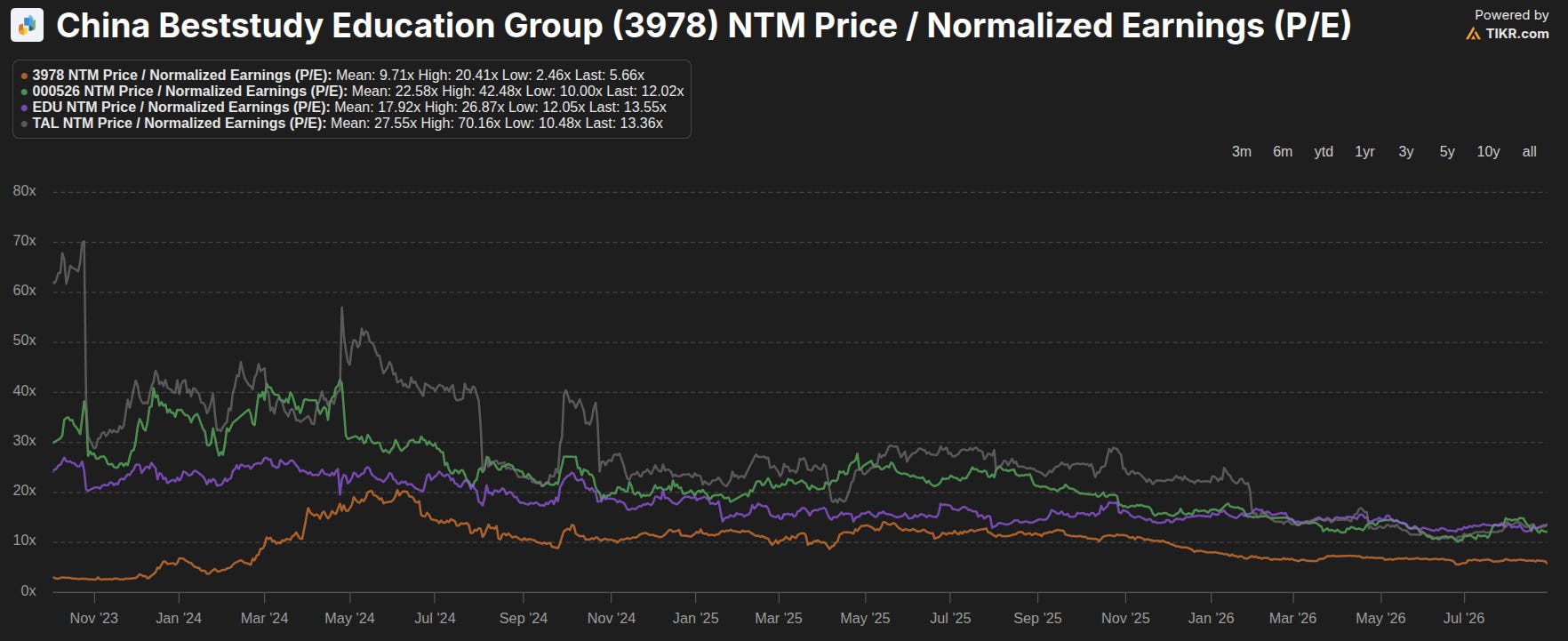
Essentially if they keep growing 15-20% a year (a significant slowdown from 2025) for the next 2 years you will get >33% of your money back in dividends and own a stub that trades at 3x earnings by YE 2028. I think expected IRR here is 10-40%, unless a change in the regulatory environment causes a collapse in earnings.
So the major question here is, what would stop China from again nuking this sector? For one the Chinese ministry of education has been pretty explicit that they do not intend to eradicate the after school education market, but merely wanted to change its way of operating. These are the criteria that determine if an afterschool company is illegal or not:
purpose: is it aimed mainly at improving subject grades?
content: does it teach Chinese, math, English, physics, chemistry, history, etc.?
method: does it resemble conventional preview → teacher instruction → exercises → reinforcement?
assessment: are grades/tests/ranking the principal outcome?
Basically Beijing doesn’t mind (and actually wants to encourage) if some students become smarter and have their horizons broadened and this causes higher grades indirectly, they just don’t like the cram school concept where high grades are the primary incentive.
So this means that Beststudy’s subjects fall into two groups, some overlap (like culture/multi dimensional thinking) and little/no overlap with school subjects like programming and robotics. So:
Old Beststudy might have said:
“Learn the Chinese curriculum, practice the test format, improve your score.”
Their literature program can instead say:
“Read literature and history, debate an author’s or historical character’s choices, formulate an argument, write an essay and present it.”
With the added advantage of also offering smaller classes.
The Chinese ministry of education actually explicitly encouraged after school education and has said there is a room for public school + for profit organizations and even has encouraged for profit to integrate with public schools. See more info on their guidelines/rules here and here. This means regulations are both a risk (further regulatory tightening) and create barriers to entry on top of a hard to replicate decades long reputation built up by existing educational companies.
Overall I would say the CCP in its current form is extremely misunderstood by Westerners. If you actually look at their actions they don’t really dislike the concept of profit. In fact they see it as something healthy, they just don’t like “bad incentives” (like tragedy of the commons situations) or monopolies.
For example they forced last mile delivery companies to raise prices as they didn’t want a few large players monopolizing all local markets. They encouraged buybacks + dividends as they want more people to own stocks instead of speculating on real estate and creating insane bubbles. They see the market as a useful tool that will essentially enhance China and serve the collective. A large stock market means China is strong (but not too large and still under the CCP thumb of course).
In fact you could argue the CCP has too much of a focus on profits as they are too restrictive on loss making companies wanting to do an IPO.
You may disagree with this approach, but they are not your typical Western socialists who hate profits for ideological reasons. The current crop of CCP leaders are essentially ruthless pragmatists who use Mao as a mascot to legitimise themselves. If Mao actually saw what Xi was doing, building up legal institutions and basically behaving like a US Republican (refusing to increase social safety nets as he thinks that will make Chinese people soft) he would probably turn in his grave.
Xi basically looked at America (he actually studied in the US) and realized that abolishing markets was stupid, they are a useful Darwinian concept to filter out winners to the top. He just didn’t like how capitalists had almost complete control over the US political system.
And he kind of has a point. For example look at the current US military procurement system, it is only a handful of mega corporations. This has caused a lot of inefficiencies where the US government often only has one and maybe 2 suppliers for many systems with rampant rent seeking.
I also can’t find that much blame in the new 2021 cram school regulations. If it really results in more time taken up by education that actually teaches children to think instead of just mindlessly cramming for tests, isn’t that actually a good thing? Given how competitive China is, this was basically creating a race to the bottom. Plus profits are now actually higher on this new model than before as quality matters more now that after school education isn’t all concentrated into dumb studying to ace exams (which is a very short sighted and miserable way of learning IMO).
Closing observations:
This recent Sohu report on the company is worth reading as it dives fairly deep into the business.
3 founders own >50%.
Over a 500 employees own shares in the company, so there is motivation to create shareholder value for insiders
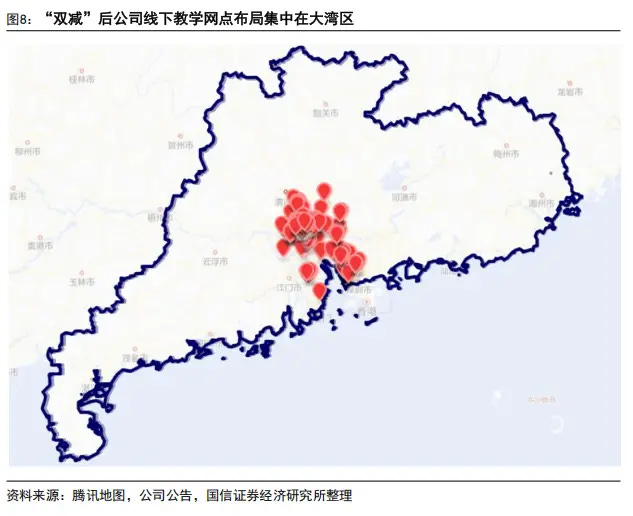
There are also restrictions on advertising, so this means Beststudy can only slowly expand outwards relying mostly on word of mouth, they are fairly locally geographically concentrated:
I think with AI and ever increasing distractions these more qualitative “learning how to think” education schools will be more in demand, not less.
There is a modest risk of increased competition from after school public programs. They will likely be limited and of poorer quality though.
I own a mid sized position in Beststudy
Disclaimer: Readers of this blog should do their own due diligence before buying or selling any of the mentioned stocks, since I have been w20-rong before and cannot guarantee all information in this write-up is 100% factual. I may buy or sell the above mentioned stocks at any time. Past success is no guarantee for future success. Some of the stocks mentioned might have poor liquidity, so make sure to check average daily trading volume before buying or selling anything. I am not your financial advisor.